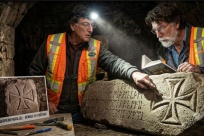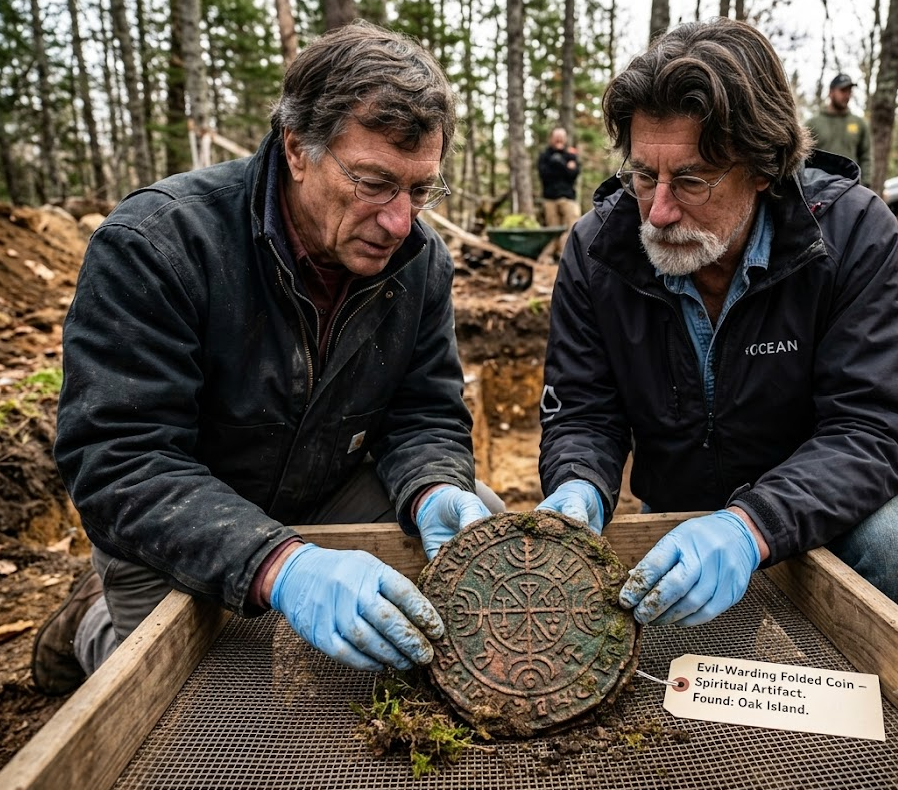
For more than two centuries, treasure hunters have searched Oak Island for objects that could point toward wealth hidden beneath the ground.
Gold coins.
Silver.
Jewelry.
Military artifacts.
Pieces of old tools.
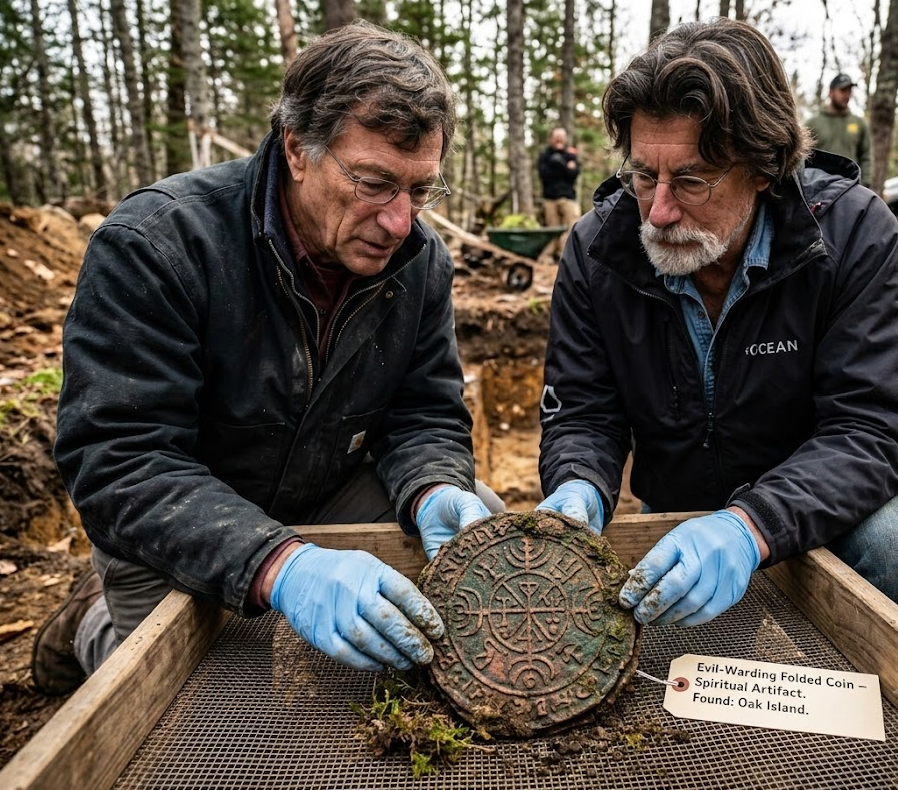
But the latest discovery from Lot 5 could be important for a completely different reason.
The object is a copper coin that appears to have been deliberately folded three times.
And according to the experts examining it, the folding may not have been accidental damage.
It could represent an old spiritual ritual associated with prayer, protection and the symbolic removal of misfortune.
For Rick Lagina and the Fellowship of the Dig, that changes the question immediately.
The value of the coin is almost irrelevant.
What matters is why someone folded it — and why it ended up on Oak Island.
A First-of-Its-Kind Discovery
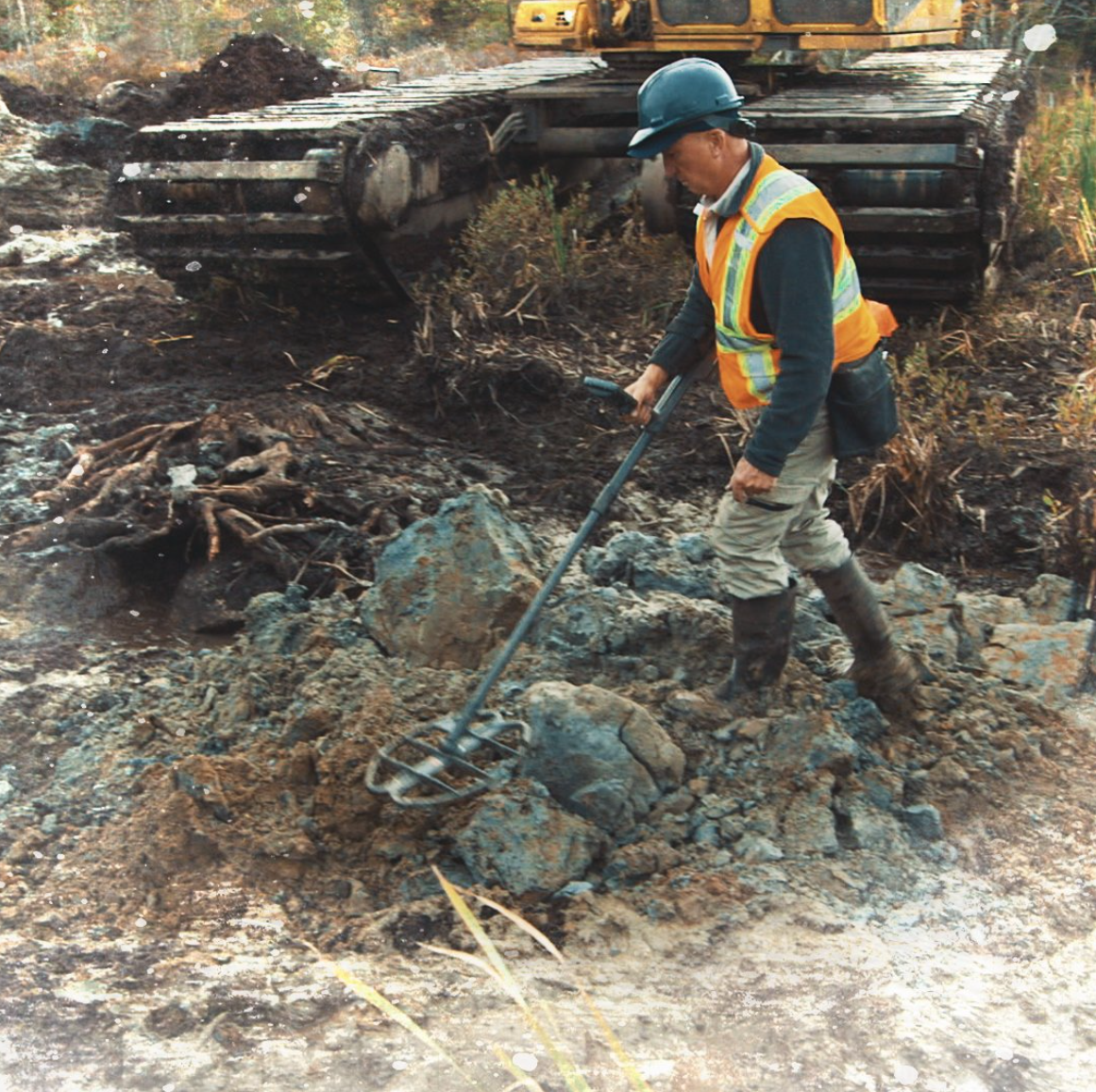
Gary Drayton recovered the unusual copper object from spoil material associated with the mysterious rounded feature on Lot 5.
Initially, even the team was unsure exactly what they had.
The metal had been folded so tightly that identifying its original form was difficult.
CT scanning did not immediately reveal a clear portrait or inscription.
But the shape appeared deliberate.
Not once.
Not twice.
Three folds.
That immediately attracted Gary’s attention because he had encountered similar objects while metal detecting in Britain.
Folded coins, he explained, have historically been interpreted as talismans or good-luck objects.
Rick later emphasized another important point:
Nothing quite like it had been recovered on Oak Island before.
That makes the artifact unusual even before its possible symbolism is considered.
The Folding May Have Been Intentional
The team’s laboratory analysis suggested the object was composed of a copper alloy containing zinc, arsenic and lead.
Those characteristics allowed Emma Culligan to place it broadly within a post-medieval period, potentially extending back toward the late 1600s.
Coin expert Sandy Campbell then offered a more specific interpretation.
He concluded that the object was indeed a coin.
And he believed the folding was intentional.
That distinction matters enormously.
A bent coin is simply damaged currency.
A deliberately folded coin becomes evidence of human behavior.
Someone made a decision to alter it.
The question is why.
A Ritual Designed to Contain Misfortune?
Campbell explained that folded-coin traditions stretch back many centuries.
One historical practice involved folding a coin while appealing to a saint for help.
Another interpretation was more symbolic.
Misfortune, illness or evil could be metaphorically trapped inside the folded metal.
Once the problem had passed, the coin could be discarded, passed to someone else or buried.
That interpretation creates one of the strangest possibilities yet surrounding Lot 5.
Someone may not have lost this coin.
They may have intentionally left it behind.
If so, the exact location where it was deposited becomes extremely important.
Was it associated with the construction of the rounded stone feature?
Was it placed there before a voyage?
After arriving?
Or was it buried as part of a ritual connected to whatever activity was taking place on the site?
Those are questions the team cannot yet answer.
The Artifact Is Probably Not Medieval
The temptation, of course, is to jump immediately to the Knights Templar.
But the dating requires caution.
Campbell explained that coin-folding practices can be traced back into medieval history.
That does not mean the Lot 5 coin itself comes from the medieval period.
Based on its size and material, he suggested a more plausible range around the 1600s or 1700s.
That distinction is crucial.
The artifact may represent the survival of a medieval tradition centuries after the original Knights Templar disappeared.
And that is where the Knights of Malta enter the discussion.
Could the Knights of Malta Fit the Timeline?
The Fellowship has previously investigated the possibility that the Knights of Malta — a later Christian military order with historical connections to crusading traditions — could have played some role in Oak Island’s early history.
The potential late-1600s date makes that theory intriguing.
Not proven.
But intriguing.
The team has already recovered other Lot 5 artifacts that appear compatible with a similar broad period, including ornate trade beads, buttons and metal objects.
If several of those finds eventually converge around the same century, the investigation could move beyond isolated artifacts toward evidence of organized activity.
The folded coin could then become one cultural clue within a much larger picture.
The East-West Alignment Adds Another Layer
Rick Lagina also notices something unusual about the rounded Lot 5 feature itself.
Its long axis appears to run roughly east to west.
That interests him because many Christian churches and certain structures connected with Templar history also followed east-west orientation.
Again, this is not proof of a Templar or Knights of Malta presence.
Orientation alone cannot establish who built something.
But Oak Island investigations rarely depend on a single clue.
It is the combination that becomes interesting.
A deliberately folded coin with possible religious meaning.
Artifacts potentially dating to the 1600s.
An unusual stone feature.
And an east-west alignment.
That is enough to justify further excavation.
Sir William Phips Remains in the Picture
There is another major theory competing for attention on Lot 5.
Sir William Phips.
The team has investigated whether Phips or people associated with his 1687 recovery of treasure from the Spanish wreck Concepción could have visited Oak Island.
The chronology again overlaps with the possible age of some Lot 5 artifacts.
This raises a fascinating possibility.
Perhaps the folded coin does not identify the group at all.
Instead, it might reveal something about the beliefs of an individual who was part of a larger expedition.
Sailors in the 17th century lived with enormous uncertainty.
Crossing the Atlantic meant storms, disease, navigation problems and limited medical help.
Carrying or depositing a protective object before such a voyage would therefore not be difficult to imagine.
What Could the Team Find Next?
The strongest evidence would be another folded coin.
If the team finds a second example in the same archaeological context, coincidence becomes much less persuasive.
A religious medal could also matter.
So could an engraved symbol.
A readable coin beneath the folds could provide a ruler, country and approximate date.
The difficulty is that physically unfolding the current artifact could damage it.
That means non-destructive scanning may remain the preferred approach.
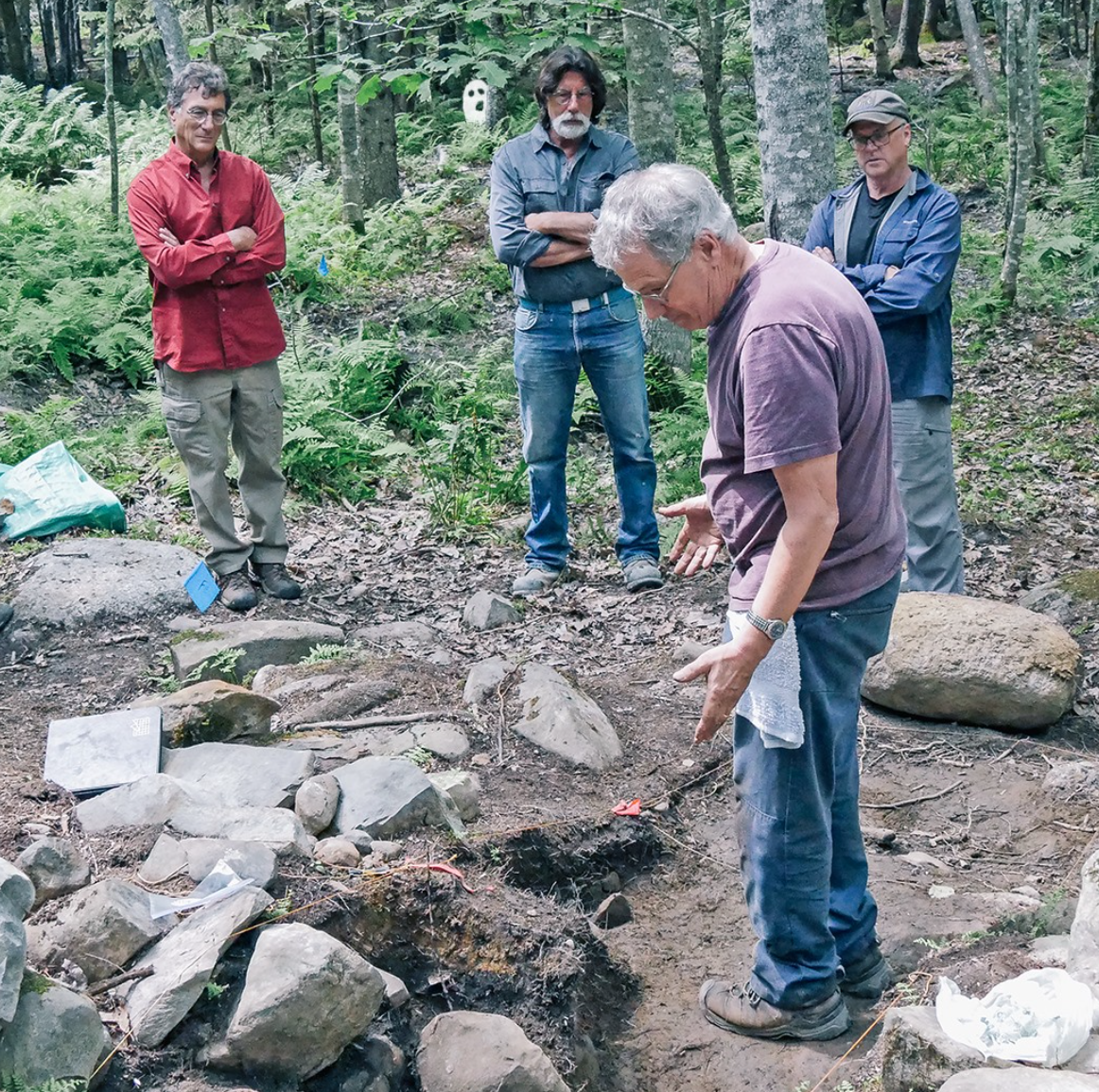
The team could also intensify excavation around the exact area where the spoil material originated.
Finding similar objects still in their original position would provide much stronger archaeological context.
Lot 5 May Be About People, Not Treasure
That may ultimately be the importance of the folded coin.
Gold tells you that someone had wealth.
A ritual object can tell you something about the person.
What they feared.
What they believed.
What traditions they followed.
And possibly where they came from.
Rick Lagina has repeatedly emphasized that solving Oak Island requires more than simply recovering treasure.
It requires identifying the people responsible for the activity.
This strange copper coin could contribute to exactly that goal.
For the first time on Oak Island, the Fellowship may have recovered an artifact that was not simply carried, spent or dropped.
It may have been deliberately transformed for a spiritual purpose.
And if the team can determine why it was placed on Lot 5, the three folds in this small piece of copper could eventually help unfold a much larger chapter of the Oak Island mystery.
Clarify the coin’s dating language
THEO DÕI CHÚNG TÔI TRÊN FACEBOOK