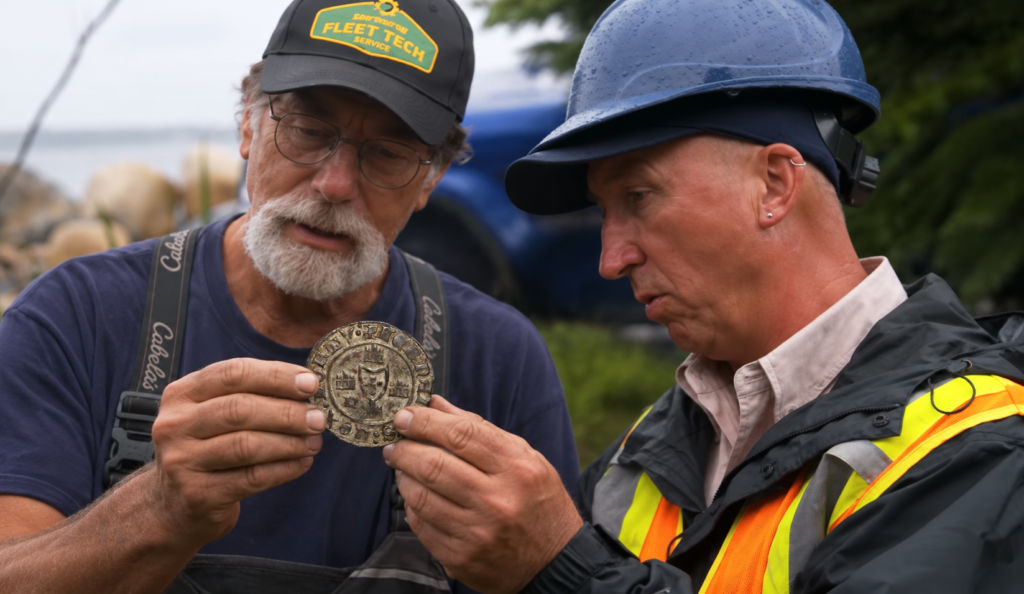
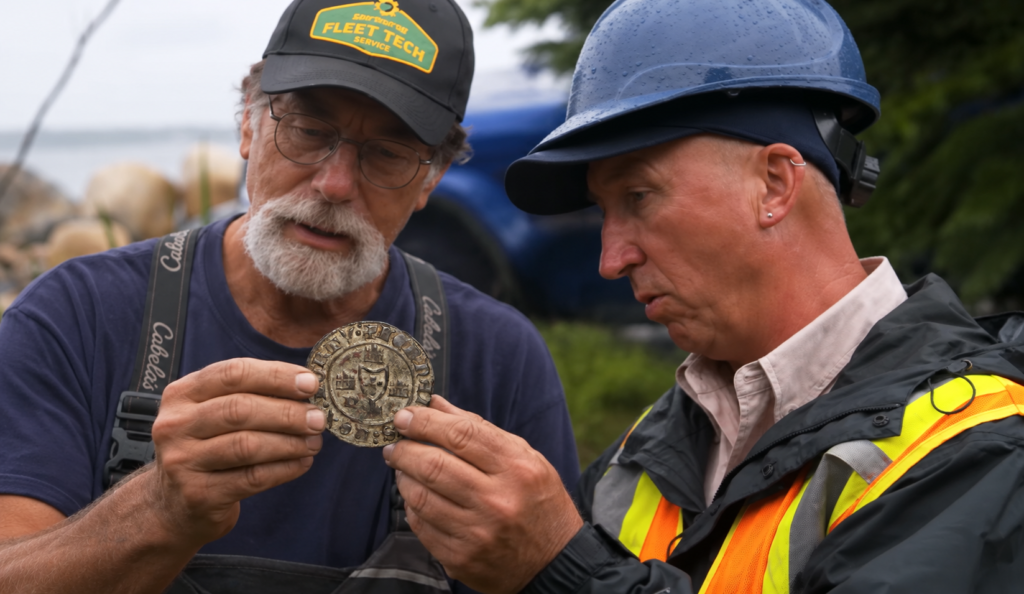
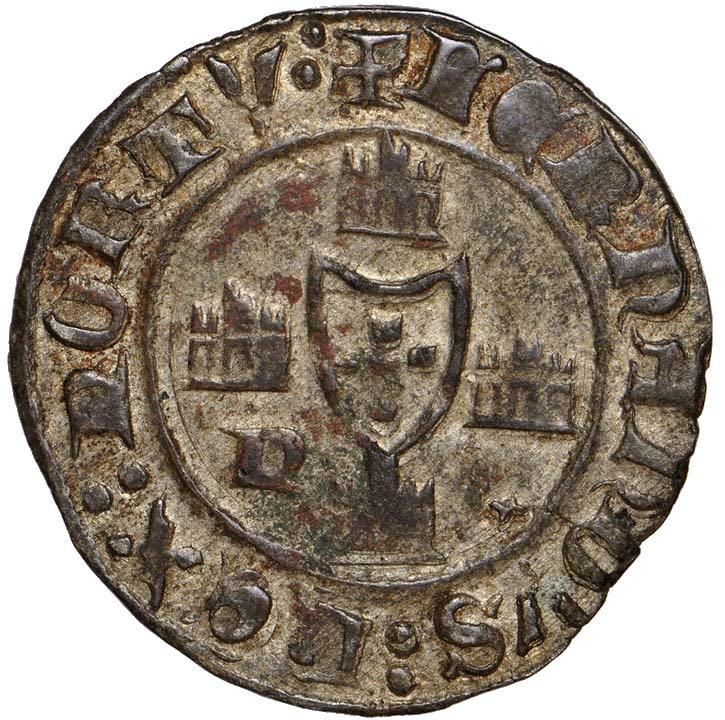
The object is a silver 1 Tostão coin linked to the reign of King Ferdinand I of Portugal and reportedly minted in Lisbon between 1369 and 1371. That places it roughly 650 years in the past — centuries before the famous Money Pit was discovered in 1795 and long before the modern treasure hunt began.
But what makes the coin especially compelling is not simply its date.
It is the story attached to it.
According to the account presented to the Oak Island team, the coin was introduced by a man named Salomon, who identified himself as a relative of James Pitblado and members of the Archibald family. He claimed that the coin had been preserved as a family heirloom and may have been connected to an object Pitblado recovered during drilling work on Oak Island in 1849.
That immediately ties the artifact to one of the island’s oldest unresolved stories.
During drilling operations by the Truro Company in the Money Pit area, Pitblado was reportedly seen handling an object brought up by an auger. Witnesses later claimed he cleaned it off and slipped it into his pocket.
When challenged, he allegedly promised to present the object at a later directors’ meeting.
He never did.
Pitblado left Oak Island and did not return, and whatever he may have recovered became part of the folklore surrounding the Money Pit.
For more than a century, that missing object has existed largely as a historical mystery.
Now, the appearance of a medieval Portuguese coin with an alleged family connection to Pitblado raises an obvious question: could this be related to the object he removed from the drilling operation?
There is no definitive proof that it is.
That distinction is crucial.
A family story, even one passed down for generations, does not automatically establish archaeological provenance. Without a documented chain of custody stretching back to 1849, investigators cannot simply conclude that the coin came from the Money Pit.
But the possibility is still significant enough to investigate.
If the coin could ever be reliably tied to Oak Island, the implications would be extraordinary.
A Portuguese coin dating to the late 14th century would immediately force researchers to ask how an object from medieval Europe ended up in Nova Scotia.
Was it carried there centuries later by another traveler?
Did it arrive through trade?

Was it part of a collection?
Or could it point toward European activity connected to Oak Island much earlier than previously documented?
Those questions fit directly into a wider theme that has become increasingly important in the Oak Island investigation.
The Lagina team has spent years examining evidence that may suggest European contact with the island before the traditional treasure-hunting era. Portuguese connections, in particular, have attracted attention through stone features, symbols, coins and research carried out in the Azores.
That is why the coin’s imagery is also interesting.
The artifact is described as carrying the Portuguese royal shield, decorative elements and Latin inscriptions associated with King Ferdinand I. Researchers also noted a cross-like design and a six-pointed star that drew comparisons with symbols seen at historical sites in Portugal.
Those similarities do not prove a connection to the Knights Templar or any specific medieval group.
But they give the team another reason to examine the object within a broader Portuguese historical context.
That investigation reportedly took members of the Oak Island team to the Azores, where Rick Lagina, Alex Lagina and Doug Crowell presented the coin to Portuguese numismatic expertise for closer examination.
That step matters.

The most useful question is not whether the coin “looks old.”
It is whether its metal composition, design, minting characteristics and wear patterns are consistent with a genuine 14th-century Portuguese coin.
If experts authenticate the object as an original period coin, the next challenge becomes provenance.
Where was it before entering the family collection?
How long had the family possessed it?
Are there letters, inventories or other documents connecting it directly to Pitblado?
And most importantly, is there any evidence that it actually came from Oak Island rather than being acquired elsewhere?
Those questions could determine whether the coin becomes a fascinating side story or one of the most important historical clues ever introduced to the investigation.
The condition of the coin adds another layer.
The text associated with the artifact describes it as being in remarkably good condition, with limited wear and few abrasive marks.
That could complicate the story.

An object that spent centuries underground in a harsh environment might be expected to show significant deterioration, depending on soil conditions and how it was deposited.
If the coin remained protected in a container or enclosed space, however, preservation could be much better.
That is exactly the kind of detail the Oak Island team will need to examine carefully.
For Rick Lagina, the attraction is obvious.
The treasure hunt has increasingly become less about one chest buried in one location and more about reconstructing a historical timeline.
Who visited Oak Island?
When did they arrive?
What did they build?
And could different artifacts belong to the same larger story?
A medieval Portuguese coin potentially linked to James Pitblado brings several of those questions together at once.
It connects a 14th-century artifact, a mysterious 19th-century drilling incident, a long-running family claim and the modern search at the Money Pit.
That combination makes it one of the most compelling leads to emerge in the wider Oak Island story.
The coin does not prove that medieval Portuguese explorers reached Oak Island.
It does not prove that Pitblado found it in the Money Pit.
And it certainly does not prove the existence of buried treasure.
But if investigators can establish even part of that chain, the historical significance could be enormous.
For now, the artifact remains exactly what Oak Island does best: a tantalizing clue suspended between documented history and unresolved mystery.
And this time, the unanswered story may have been waiting for more than six centuries.
THEO DÕI CHÚNG TÔI TRÊN FACEBOOK