In a series of back-to-back excavations across multiple lots, the fellowship spearheaded by Rick and Marty Lagina has unearthed a stunning, jewel-encrusted artifact alongside a network of underground stone voids that have left archaeologists and researchers questioning everything they know about the island’s early history.

The discoveries, which span from the historical footprint of early settlers to the mysterious properties once owned by legendary resident Samuel Ball, have injected fresh momentum into an expedition that many critics believed had hit a dead end.
A ‘Bobby-Dazzler’ on Lot 21 The first major breakthrough occurred on the pristine and previously unsearched ground of Lot 21. Navigating the surrounding perimeter of the protected historical rock foundation belonging to Daniel McGinnis—the man who originally co-discovered the infamous Money Pit in 1795—metal detection expert Gary Drayton struck literal and historical gold.
Drayton’s detector bypassed modern iron signals to yield a shallow reading that revealed a heavily ornate, stone-set jeweled brooch. Flashing a brilliant crimson gem under the Nova Scotian sun, the heavy artifact bore an uncanny resemblance to a 16th-century semi-precious brooch unearthed last year on Lot 8, nearly a mile away.

“Gary reached in, and there it was… a holy-schmoly moment,” an ecstatic Rick Lagina recounted. “If it predates searcher activity, it’s absolutely an excellent find. A lot of work went into that, which tells us this could be special.” The find was quickly cataloged alongside two separate, ancient decorative iron hinges recovered from a nearby historical dump site on Lot 12.
Analysts suggest the hinges match those recovered from Spanish shipwreck chests, fueling theories that hidden wealth was actively being deposited, transferred, or unpacked on the island long before formal excavation records began. The Samuel Ball Anomaly While the island’s surface continues to yield personal treasures, the ground beneath the Samuel Ball foundation has exposed what the team is calling a potential “aha moment.”
Ball, a former slave who escaped to Nova Scotia in the late 1700s, achieved legendary status on the island after inexplicably amassing a massive personal fortune, becoming one of the region’s wealthiest landowners.

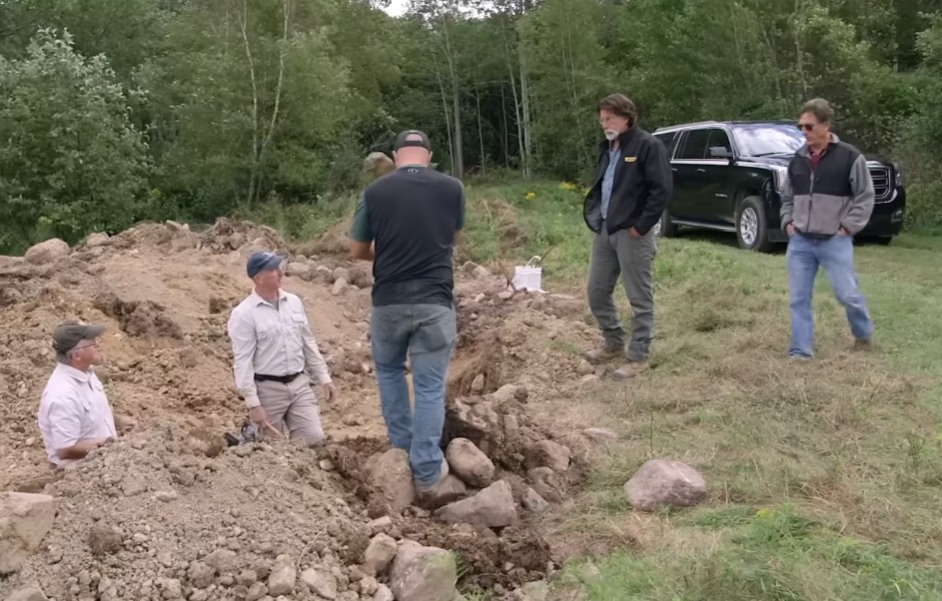
Working alongside archaeologist Laird Niven and camera operator Derek Hale, the team excavated a structural anomaly that led directly into a precisely engineered, man-made stone tunnel. A remote underground camera navigated 14.5 feet into the claustrophobic stone channel, revealing a sophisticated, flat-rock ceiling before jamming against a massive stone obstruction. A Tunnel to Nowhere?
While a large boulder blocked the camera’s visual path, probe testing revealed highly disturbed, soft soil continuing deep behind the barrier—suggesting the blockage may have been intentionally dropped into place to seal off the vault. The architectural discovery aligns perfectly with a hoard of ancient tunneling tools, including a 600-year-old iron chisel and structural swages, found scattered across nearby lots over the past year. “It’s a complete mystery what this is, but it can’t be a tunnel to nowhere.
Nobody would do that,” Marty Lagina declared, pushing for immediate hand-excavation. “If there was a treasure recovered by Samuel Ball, maybe it still survives him, and it’s somewhere around that foundation.” As the expedition prepares to bypass the subterranean blockages with manual labor, the team remains unbothered by the typical setbacks that have plagued searchers for over two centuries.
On Oak Island, nothing comes easily—but the secrets hidden behind the stone walls of Samuel Ball’s estate are closer to the light than ever before.
THEO DÕI CHÚNG TÔI TRÊN FACEBOOK