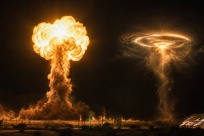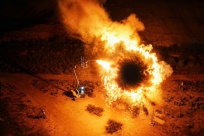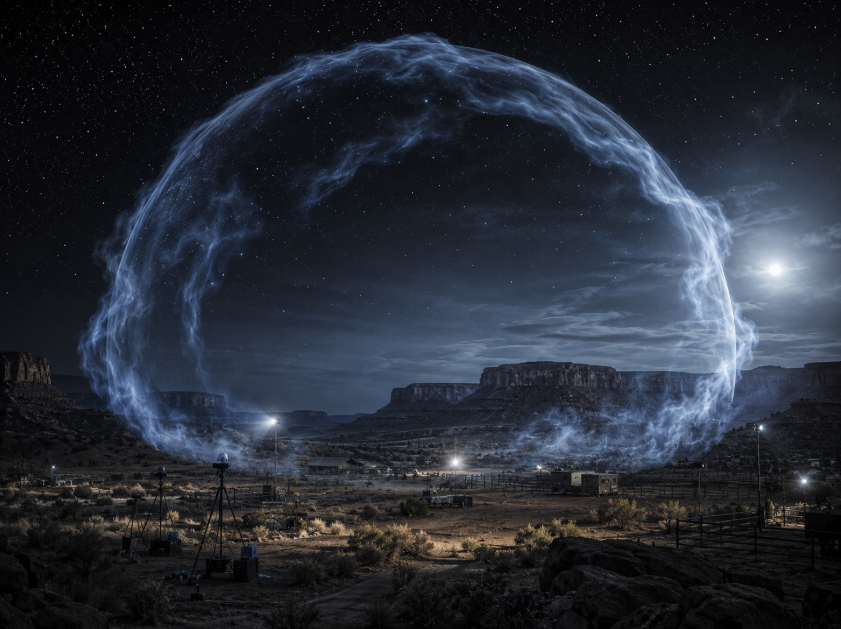
As rings and plumes moved through the suspected bubble boundary, some began to deform along specific regions instead of breaking randomly. If that pattern can be repeated, the smoke may be doing more than reacting to turbulence it may be sketching the height, curvature, and thickness of an invisible structure hanging over Skinwalker Ranch.
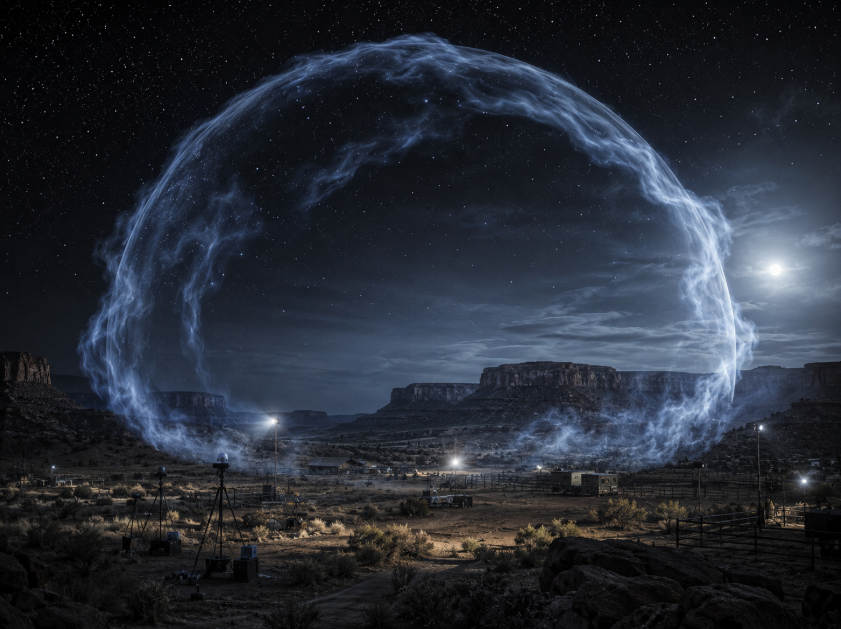
THE SMOKE RISES AND AN INVISIBLE BOUNDARY MAY BEGIN TO DRAW ITSELF
The challenge at Skinwalker Ranch has never been a shortage of strange events. It has been turning those events into something that can actually be mapped. The suspected bubble anomaly has been inferred through rocket deflections, GPS distortions, unusual sensor behavior, and repeated activity around the Triangle and Mesa, but an invisible boundary remains difficult to define if no one can see where it begins or ends.
That is what made the smoke experiments so valuable. Unlike rockets, which move through the target area in seconds, smoke remains visible long enough for investigators to watch how its shape changes as it climbs. A clean ring provides an especially useful reference because its geometry is easy to recognize. If the ring rises normally, the surrounding air may be behaving normally.
If one side compresses, stretches, tears, or bends at a specific altitude while the rest remains coherent, the disturbance becomes spatially meaningful. During the bubble experiment, the team saw smoke formations behave differently as they moved through the suspected anomalous region. Some rings held together. Others became distorted or began losing their symmetry. The obvious explanation is turbulence, and that must remain on the table.
But the real power of the experiment comes from repetition. If deformation repeatedly occurs in the same part of the sky rather than randomly, the smoke stops being just theatrical debris from an explosion. It becomes a tracer. And for the first time, the team may have a way to let the invisible anomaly draw its own outline.
EACH DISTORTED RING COULD REVEAL HEIGHT, CURVATURE AND THICKNESS
The next step would be to treat every smoke ring not as a spectacle, but as a moving measuring instrument. Multiple synchronized cameras could reconstruct the ring in three dimensions as it rises through the target region. If the same portion of each ring bends at the same altitude, investigators could begin estimating the height of the disturbance. If deformation travels along a curved path, that could reveal whether the suspected boundary is flat, spherical, dome-shaped, or irregular.
The rate at which the ring enters and exits the distorted zone might even provide clues about thickness. A thin boundary would produce a brief, localized change. A deeper region could affect the smoke over a larger vertical distance. This is where the bubble hypothesis becomes testable in a new way. Instead of saying that something appears to affect smoke, the team could begin assigning coordinates to the interaction.
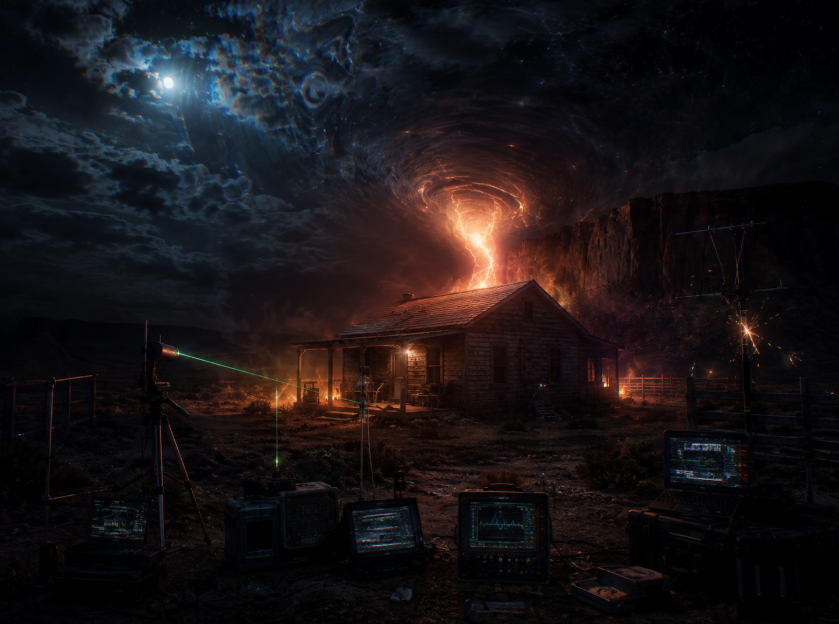
Laser grids could be added as fixed reference planes while smoke moves through them, giving investigators known geometry against which to compare any deformation. Wind speed, pressure, temperature, and atmospheric conditions could be measured simultaneously to eliminate simpler explanations.
If the smoke repeatedly warps along the same invisible curve while nearby control plumes remain unaffected, the team would have something far more powerful than another anomaly story. They would have the beginnings of a map. And that map could finally be compared with the locations where rockets have deviated, GPS data has failed, thermal signatures have appeared, or UAP activity has clustered.
IF THE SHAPE CAN BE MAPPED, THE BUBBLE STOPS BEING A THEORY AND BECOMES A TARGET
That would change the entire strategy of the investigation. Until now, the suspected bubble has often been treated as a broad region inferred from scattered effects. But a measurable shape would allow the team to attack specific points on the boundary instead of simply firing through an approximate area.
They could test the highest point, the edge, the thickest section, and any location where smoke deformation becomes strongest. Rockets could be aimed through those coordinates. Lasers could probe the curvature. Thermal cameras could watch for changes along the surface.
RF and GPS systems could be placed on opposite sides to determine whether the boundary affects signals differently depending on position. Most importantly, the team could test whether the shape changes after stimulation. Does the bubble expand after an explosion? Does its edge become more disruptive after repeated hits? Does the same curved region that tears smoke also correspond with later UAP activity?
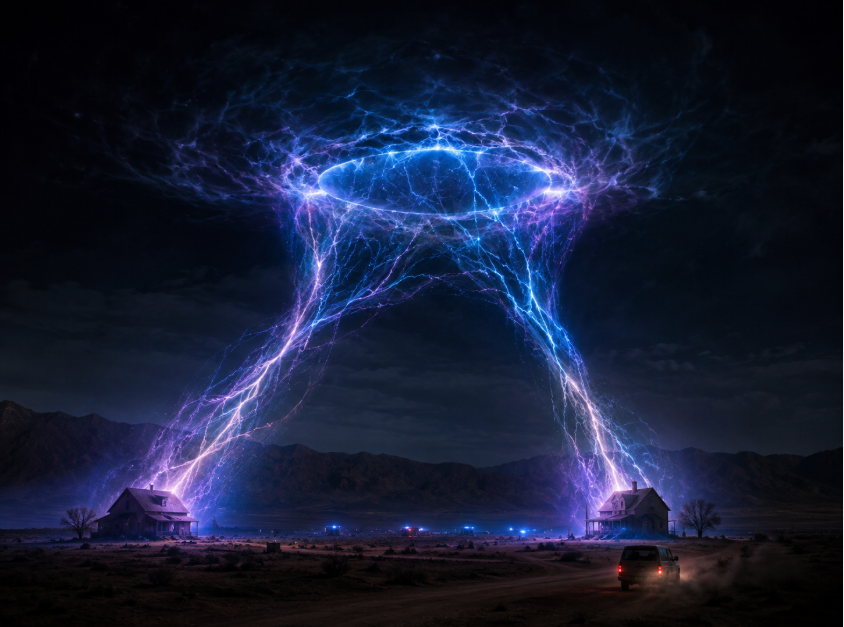
If those patterns repeat, Skinwalker Ranch would move closer to one of its biggest breakthroughs yet: transforming an invisible anomaly into a structure with measurable geometry. No single distorted smoke ring can prove that such a structure exists. Wind, blast dynamics, and atmospheric turbulence can all create strange shapes.
But that is exactly why the geometry matters. Random turbulence should not repeatedly draw the same boundary. If the smoke keeps bending along the same curve, at the same height, across controlled tests, the anomaly may finally be losing the advantage it has held for years. The team may not be able to see the bubble directly. But they may have found something better a way to make the air reveal where it is.
THEO DÕI CHÚNG TÔI TRÊN FACEBOOK