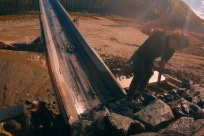
The dramatic gold weigh-ins at the end of every Gold Rush episode are the ultimate payoff for both the miners and the television audience. When 31-year-old Parker Schnabel or 66-year-old Tony Beets pours hundreds of ounces of raw Klondike gold onto the digital scale, the numbers quickly translate into millions of dollars. But behind the cheering, the clinking of gold in the pan, and the popping of champagne at the end of the season lies a massive, highly guarded financial secret.
How much of that glittering fortune actually goes to the men and women covered in mud and diesel grease?
The Gold Rush fan community is constantly debating the financial mechanics of crew compensation. If Parker pulls in a staggering $10 million in a single season, how exactly does he calculate and distribute the end-of-season gold bonuses to his loyal operators? The truth is a complex mixture of standard payroll, television residuals, and highly calculated profit-sharing that dictates exactly who gets rich in the Yukon.
The Harsh Reality of Operating Costs
To understand the gold bonus, you first have to understand the brutal economics of Klondike placer mining.The millions of dollars flashed on the Discovery Channel represent gross revenue, not pure profit. Placer mining is an astronomically expensive endeavor, with industry standards dictating that 60% to 85% of gross revenue is instantly swallowed by operating costs—specifically diesel fuel, land royalties, equipment leases, and massive maintenance bills.
Because the mine bosses shoulder 100% of this multi-million-dollar financial risk, the crew members do not receive an equal share of the final weigh-in.Instead, the baseline of their compensation is a standard salary or hourly wage. A competent heavy equipment operator running a rock truck or a bulldozer in the Yukon typically earns between $30 and $40 per hour. When you factor in the grueling 10-to-16-hour shifts, six days a week, for a five-month season, a standard operator can easily earn a base salary of $60,000 to $80,000.
In addition to this base pay, the mine boss covers all room and board on the claim. Furthermore, any crew member whose face appears on camera receives an entirely separate paycheck directly from the Discovery Channel for their television appearance, providing a massive secondary income stream that softens the blow of a bad mining season.
The End-of-Season Gold Bonus Structure
While the base salary pays the bills, it is the end-of-season gold bonus that keeps the crew motivated to work 20-hour shifts in the freezing mud. The bonus structure on Gold Rush closely mirrors the compensation model seen in commercial crab fishing, heavily weighted by experience, loyalty, and rank.
For veteran foremen and lead mechanics—like Parker’s trusted right-hand men, Mitch Blaschke and Tyson Lee—the bonus is typically structured as a highly guarded percentage of the total seasonal haul. Mining insiders estimate that top-tier foremen negotiate a baseline salary plus a bonus of roughly 0.3% to 0.5% of the total gold recovered.

While half a percent sounds small, the mathematics of the Klondike make it incredibly lucrative. If Parker Schnabel hits a historic 10,000-ounce season (worth approximately $25 million at current gold prices), a 0.5% cut translates to a staggering $125,000 bonus on top of their base salary and Discovery Channel checks. This performance-based percentage ensures that the mechanics are financially incentivized to "rip themselves in half" to keep the wash plants running; every ounce of gold lost to mechanical downtime is money directly out of their own pockets.
For the lower-tier greenhorns and standard rock truck operators, the bonus is rarely a set percentage. Instead, bosses like Parker often distribute flat-rate bonuses based on hitting specific seasonal milestones. If the crew reaches the 5,000-ounce or 7,000-ounce goal, Parker is famous for handing out physical, heavy gold coins or raw nuggets to his crew during the final weigh-in. This acts as a tangible, high-value reward for surviving the brutal Yukon summer.
Team Tony vs. Team Parker
The methodology of distributing these bonuses differs wildly between the two biggest empires in the Klondike.
Tony Beets runs Tamarack Inc. as a fiercely guarded family syndicate. Because his wife, Minnie, manages the accounting, and his children—Kevin, Monica, and Mike—serve as his primary foremen, the largest percentage of the gold profits never actually leaves the Beets family bank accounts. Tony’s hired hands receive their hourly wages and standard end-of-season bonuses, but the true wealth generation is kept strictly in-house. This is how the Beets family has collectively amassed an estimated $20 million net worth.

Parker Schnabel, on the other hand, relies entirely on an outsourced crew of hired mercenaries. Because he does not have family members running his wash plants, Parker must use aggressive financial incentives to guarantee absolute loyalty. Parker is known in the industry as a boss who pays incredibly well when the massive ounce goals are met. He leverages these massive cash bonuses and gold payouts to ensure that elite mechanics return to Dominion Creek year after year, rather than starting their own independent operations.
Ultimately, the end-of-season bonus is the ultimate psychological tool in the Klondike. When a boss screams at an operator to move faster, it isn't just about the company's bottom line. Every extra bucket of paydirt pushed through the trommel increases the size of the gold payout at the end of the summer. In the Yukon, that bonus is the absolute difference between going home as a working-class machine operator, or returning to civilization with a life-changing Klondike payday.
THEO DÕI CHÚNG TÔI TRÊN FACEBOOK